Housing affordability influences how many households can purchase a home. The National Association of Realtors’ (NAR) Housing Affordability Index compares median family income with the income needed to qualify for a median-priced home. A value of 100 means a median-income family has exactly enough income to qualify for a loan.
What This Indicator Measures
This indicator measures the ratio of median family income to the income required to qualify for a mortgage on a median-priced home, assuming a 20% down payment and spending about 25% of income on the mortgage. When the index is above 100, median income is higher than the qualifying income; when below, it signals affordability stress.
Why This Indicator Matters
Affordability shapes housing demand and price growth. When mortgages and incomes align to keep the index above 100, more households can buy homes, supporting sales. When the index falls, fewer buyers can qualify, limiting demand and slowing price appreciation.
6-Month Historical Trend
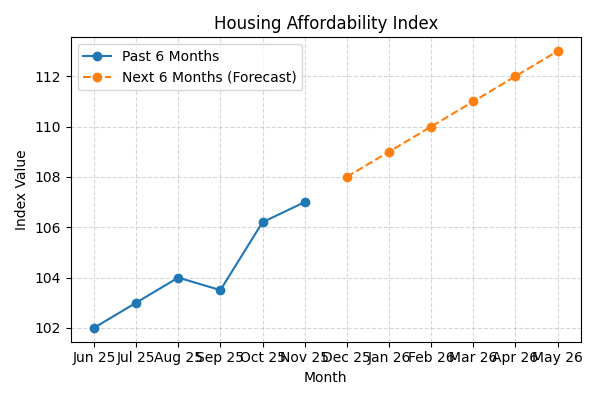
The index improved over the second half of 2025 as mortgage rates eased and incomes grew. According to the National Association of Realtors, the national Housing Affordability Index rose to 106.2 in October 2025—meaning the typical family earned 106.2 % of the qualifying income—up from around 102 in mid‑2025. Median family income increased 3.8 % and the 30‑year mortgage rate declined 18 basis points versus a year earlier, partly offsetting a 2.2 % rise in the median existing‑home price【589875587976800†L846-L913】. Regional differences remain: the Midwest is most affordable (index 134.4) while the West is least (75.2)【589875587976800†L882-L889】.
6-Month Forward Outlook (Forecast)
Looking ahead, the index is expected to remain near the mid‑100s as income growth continues to outpace price gains and mortgage rates drift lower. Slower home-price appreciation and steady wage growth should boost affordability modestly, keeping the index above 100 but still below its long‑term average.
What This Means for Buyers, Sellers & Investors
- Buyers: A modest improvement in affordability means more families will qualify for mortgages. House‑hunting budgets should stretch a bit further, but limited inventory still creates competition.
- Sellers: Slightly better affordability supports demand but doesn’t guarantee rapid price increases. Pricing homes competitively and being flexible on concessions can help attract qualified buyers.
- Investors: Gradual improvement in affordability could encourage renters to consider buying, potentially reducing rental demand. Multi‑family investors should monitor occupancy trends, while single‑family investors may face higher tenant turnover.Indicator Status (Risk Level)
Risk Level: Medium – Affordability conditions are improving but remain stretched relative to long‑term norms. We assign a yellow medium‑risk rating.

